
The City of Wenatchee, Washington, in partnership with Sustainable North Central Washington (NCW), recently completed its first comprehensive greenhouse gas (GHG) inventory. The inventory examined emissions for 2023, following the GHG global protocol for community-scale inventories and the Washington Department of Commerce climate element guidance. It took into consideration both locally generated and consumption-based emissions for the community and city operations.
The 2023 community inventory establishes Wenatchee’s first quantitative baseline for emissions—approximately 712,000 metric tons of CO₂e (MTCO2e)—and shows that local building energy and transportation together account for about 96% of locally generated emissions, with smaller contributions from industrial processes, waste, and wastewater. That averages out to 9.8 MT CO2e per person, below the Washington State average of 11.1 MTCO2e per person.
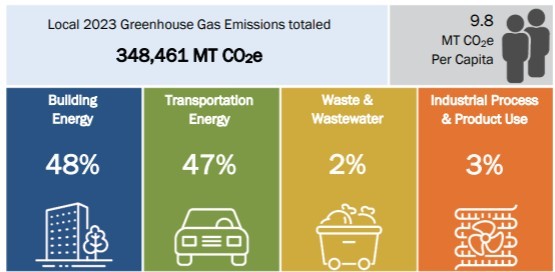
The inventory directly feeds into a concise strategic plan that prioritizes high-impact, cost-effective GHG reduction strategies in sectors like building electrification, energy efficiency, and low-carbon transportation. It models business-as-usual and policy-driven futures using state requirements, such as the Climate Commitment Act (CCA), and Advanced Clean Cars, to show how local action complements existing regulations.
The City of Wenatchee now has a clear implementation roadmap that they can use to support climate-related funding, align the Comprehensive Plan climate element, and track progress over time. By clearly identifying “hot spots” and separating municipal operations from broader community emissions, the project gives Wenatchee a focused picture of where action will matter most and where the city can lead by example.
This analysis gives Wenatchee a clear, data-driven picture of where emissions are headed and where action can make the biggest difference. Communities that complete greenhouse gas inventories consistently see stronger reductions, and this report provides a practical foundation for future planning, clean energy investment, and the next Community Action Plan.
Parametrix led the inventory, coordinating with city staff, Sustainable NCW, and regional partners to collect activity data. Technical work included:
- Conducting GHG calculations and quality control
- Building a detailed audit trail for future updates
- Translating results into an accessible baseline report and strategic roadmap.
- Facilitating a project review group of key city, utility, and community stakeholders to shape and prioritize GHG reduction strategies
The Wenatchee GHG inventory is part of a broader body of work in Eastern Washington by the Parametrix Climate team, which includes:
City of Wenatchee Comprehensive Plan – Resiliency sub-element
Parametrix is leading the technical team on Wenatchee’s Climate Change & Resiliency Sub-Element, with BERK as a planning and engagement partner. The work is part of the City’s Comprehensive Plan update, which must incorporate climate resiliency under Washington’s Growth Management Act.
Chelan County GHG inventory and strategy
Chelan County, with Our Valley, Our Future (OVOF), completed a county-wide GHG inventory and strategy that will complement and coordinate with Wenatchee’s work. The County effort is explicitly tied to the same Post Carbon Economy initiative and is expected to align methods and baselines with Wenatchee so results can be compared and rolled up at the regional level.
Wildfire emissions and regional climate impacts
As part of the broader valley effort, Parametrix provided detailed wildfire-related emissions as a critical component of regional climate risk and air quality, with the goal of linking wildfire-driven GHGs and health impacts to resilience, land-use, and energy strategies being advanced through the Wenatchee and Chelan County planning processes.
About the Author